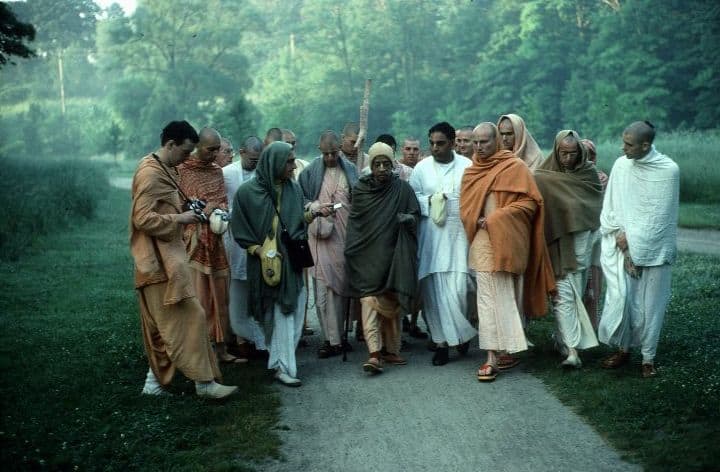
Founder-Acharya of the International Society for Krishna Consciousness (ISKCON):
His Divine Grace A.C. Bhaktivedanta Swami Prabhupada
Recent Posts from our Content Channels: |
|||
|---|---|---|---|
by Vijay Venugopal dasa and Prema Padmini dd
A sunny day at last! For people who live in the tropics, this is nothing special. But in the temperate regions, when the weather turns cloudy and rainy, the sun is something to long for. We had breakfast of bread and cheese, and went for the seminars at eight o’clock.
Carudesna Prabhu recapped that the evolution of the mind takes place in four stages:
by Sita-pati das
I'd always chalked up the success of Bhakti-vriksha among ex-pat. Indian populations to "cultural predisposition" to Krishna consciousness. Now, this is true. However, it's a special case of a general principle that can also be applied to Western populations. That is, that Bhakti-vriksha groups fulfill a social and psychological need of the participants, and they do so in a Krishna conscious way.
The homesick and newly nationally chauvinistic young student in a foreign land (I'm sorry, but New Zealand is the best damned country in the world) has psychological needs that participating in a Bhakti-vriksha group fulfils. The role of temple as a hub of social life is also fulfilled, especially in Muslim countries where temple worship and congregation is forbidden, and where Bhakti-vriksha preaching had its earliest successes.
So what this means is that Bhakti-vriksha is not impossible among populations who are not "culturally predisposed" to Krishna consciousness, it's just a question of understanding what their psychological and social needs are, and meeting those in the context of the small group program, in a Krishna conscious way.
by Ravindra Svarupa das
In Bhagavad-gita (5.22) Krishna says this about enjoyment of the senses:
ye hi samsparsha-ja bhoga duhkha-yonaya eva te
"The pleasures that arise from contact between the senses and their objects are in truth the sources of all suffering."
The Sanskrit word bhoga (with the long 'a' of the plural) means 'pleasures' or 'enjoyments.' What kinds? The pleasures born (ja) from samsparsha, 'the bringing into contact'—implicitly, the contact of the senses with their appropriate objects.
This is what we mean by "sense gratification": enjoying the pleasures that arise when the eyes, or nose, or tongue, the hands, skin, or genitals comes together with their particular objects.
As an addendum to the previous post, specifically the point about the paradox of effort and grace, I'd like to recount something from my own experience.
In 2005 I spent the day with Dr. John C. Maxwell, pastor, author, and leadership educator. My work paid for me to go. I have a yearly discretionary training allowance that I was able to use for the day, although I had to pay any associated travel and accommodation costs. The day was called "The Leadership Effect," and consisted of Dr Maxwell speaking on the theme of leadership.
As he explained at the outset, he is a "motivational teacher," rather than a "motivational speaker". A motivational speaker and a motivational teacher both make you feel good when they speak. The difference is that with a motivational speaker when you wake the next morning you don't know why, whereas with a motivational teacher you take away knowledge that you can apply.
by Kaunteya das
I find this article relevant because I consider it to be a balanced, no-hype introduction to the concept of moving to a small group model in one's community:
www.acpi.org.uk/articles/explainingcellchurch.htm
This comes from the Anglican Church Planting Initiatives, from UK. The Anglican Church has been experiencing a dramatic decrease in membership.
by Partha-sarathi das
Hare Krishna, this video was given to me, shows how the holy name changes our hardened hearts. Enjoy!
This article from Kaunteya Prabhu has originally been published on 1 June, 2007. Finding that the contents is relevant to his present work, he's re-published it on his blog now. Since some interesting comments have been made to the original article, I'm pulling that one up again.
This is something I wrote a couple of years ago. I re-read it today and I found it still relevant; perhaps more relevant today (we are closer to the future today than two years ago, right?). As I keep working on the curriculum for "Building Vibrant Vaisnava Communities," these issues keep coming up and force themselves as fundamental for the consideration of our next generation of leaders.

Vaisnavi Rani Mataji from Germany posted this as a comment to Kaunteya Prabhu's blog post Let's Talk about Tithing. Hoping that other readers may have something to say about this topic, I've published her comment as a separate forum topic here:
Thank you very much, Kaunteya prabhu, for this article. While reading it I felt a strong urge to comment.
It seems that you want to encourage us to give more donations to ISKCON temples and projects. I honostly feel that the topic you are adressing here includes many other aspects that have not been mentioned in your aricle. In this coherence I want to thank Prema Padmini prabhu for posting the following principles of an effective temple in the Congregational Preaching journal, April 2002.
by Kaunteya das
Following from the end of the previous entry, where I was talking about the phenomenon of not always focusing on developing the human and devotional potential we already have, I want to discuss one possible cause: the fear of being surpassed by these people.
Yes, many members of our congregation—although they might not have experienced the strict life of asceticism afforded to asram residents—are actually extremely brilliant and resourceful people; often more experienced, prepared and functional than many of our temple residents.
Even if they are not "better" than the temple devotees, just the fact that they may be on the same level (in terms of faith, intelligence, age, communication skills, earning power, dedication to spiritual advancement, etc.) constitutes an unspoken threat to some of the asram residents.
by Kaunteya das
I am in ISKCON Radhadesh, Belgium, www.radhadesh.com / www.bhaktivedantacollege.com, putting together the course called (working title) "Building Vibrant Vaisnava Communities."
The course will be part of the two year leadership course the GBC Succession Committee is preparing and planning to launch on three continents within 2009. The idea is that people would attend six terms of two weeks each (a total of twelve weeks), and will practice what they learn in the intervals (approximately of three and half months after every term).
by Madhava Gosh das
Christmas used to be about the birth of Jesus, now it has devolved into a pagan holiday of orgiastic consumerism. One tool used by the hedonists to achieve this was Santa Claus.
Santa Claus is alledgedly based on Saint Nick, but how far he has strayed. Here is who Saint Nick really was:
"The true story of Santa Claus begins with Nicholas, who was born during the third century in the village of Patara. At the time the area was Greek and is now on the southern coast of Turkey. His wealthy parents, who raised him to be a devout Christian, died in an epidemic while Nicholas was still young. Obeying Jesus' words to "sell what you own and give the money to the poor.
Tithing—donating a tenth of one’s income to the Church (or any spiritual organization)—enjoys long tradition and wide acceptance in Christianity; but it’s less famous and less practiced in ISKCON. Among Christians there are proponents as well as opponents to tithing, but I am not going to delve into their hair-splitting argumentations or their Bible-quoting and counter-quoting. After all, this article is not about what good Christians should or shouldn’t do, but what practices Srila Prabhupada’s followers should adopt.
by Kaunteya das
Groupthink is defined as "a type of thought exhibited by group members who try to minimize conflict and reach consensus without critically testing, analyzing and evaluating ideas. ...members of the group avoid promoting viewpoints outside the comfort zone of consensus thinking."
The motives that have been identified include wishing to avoid being seen as foolish, as disloyal or as a "separatist." Sometimes it's just the burning, desperate desire for acceptance that makes us subordinate our power of discrimination to whatever the circumstantial leader wants us to do or think.
Originally Vasu Murti Prabhu posted this as a comment to the article India's Imams urge Religious Respect, imported from Kripamoya Prabhu's blog The Vaishnava Voice.
I find this topic sufficiently important, especially at this time, when public opinion tends to consider Muslims in general a bunch of savage terrorists. Using relisgious teachings to justify political aims and tactics that are completely irreligious in nature isn't something today's 'Islamic' terrorists invented; think of the medieval crusaders, or the 'Holy Roman Inquisition,' per example.
There's already several posts about Christianity and vegetarianism on Vasu Murti's blog; this article provides arguments for devotees preaching to followers of Islam—I mean those who really try to understand and follow it's teachings; if you find yourself opposite some hardened terrorist, a kalashnikov or HK5 would probably be a more suitable argument.
Here is an excerpt of a book Sita-pati Prabhu is working on, published as a blog post at www.atmayogi.com. I find it quite excellent, even this pre-release, and want to share it with our readers.
Sita-pati explains how one's ability to lead—society, an organization, a single temple or center, or just one's own life—depends on the ability to see things as they are, to "get real."
The author's introduction:
Further to yesterday's post about the "incompetent and ignorant", here are a few thoughts on the subject that I jotted down this morning. Far be it from me to just call people losers and and leave it at that.
Actually, this is an excerpt from my as yet unpublished book on Leadership. It's a little long, but it really is good stuff—if I do say so.
by Vijay Venugopal dasa and Prema Padmini dd
We felt so much at home with the Russian devotees that we consider Russia our second homeland now! This festival was especially for grihastas, who are the base asrama on which the other three, brahmacari, vanaprastha, and sannyasa, depend. Therefore grihastas must be solid devotees, motivated to build a strong Vaisnava community in each village, town, and city, to help the Golden Age of Lord Caitanya to blossom.
It appears that India and Russia might occupy leading positions in this revolution, considering the number of serious devotees in these two countries, and their book distribution scores. I said we would describe how grihastas could lead their lives in such a way that they were strong and happy while preaching. We have counseled hundreds of devotees in leading a happy married life.
Yoga is becoming a controversial topic these days. Devotees practice it for health reasons and as a means to reach out to an audience increasingly aware of and open to health and new age trends.
Now the Malaysian National Fatwa Council has banned Muslims in that country from practicing yoga, according to this BBC News article:
Millions of people in Malaysia have been banned from doing yoga because of fears it could corrupt Muslims.
The Islamic authorities have issued a ruling, known as a fatwa, instructing the country's Muslims to avoid yoga because of its Hindu roots.

by Jeyanthy Pillai
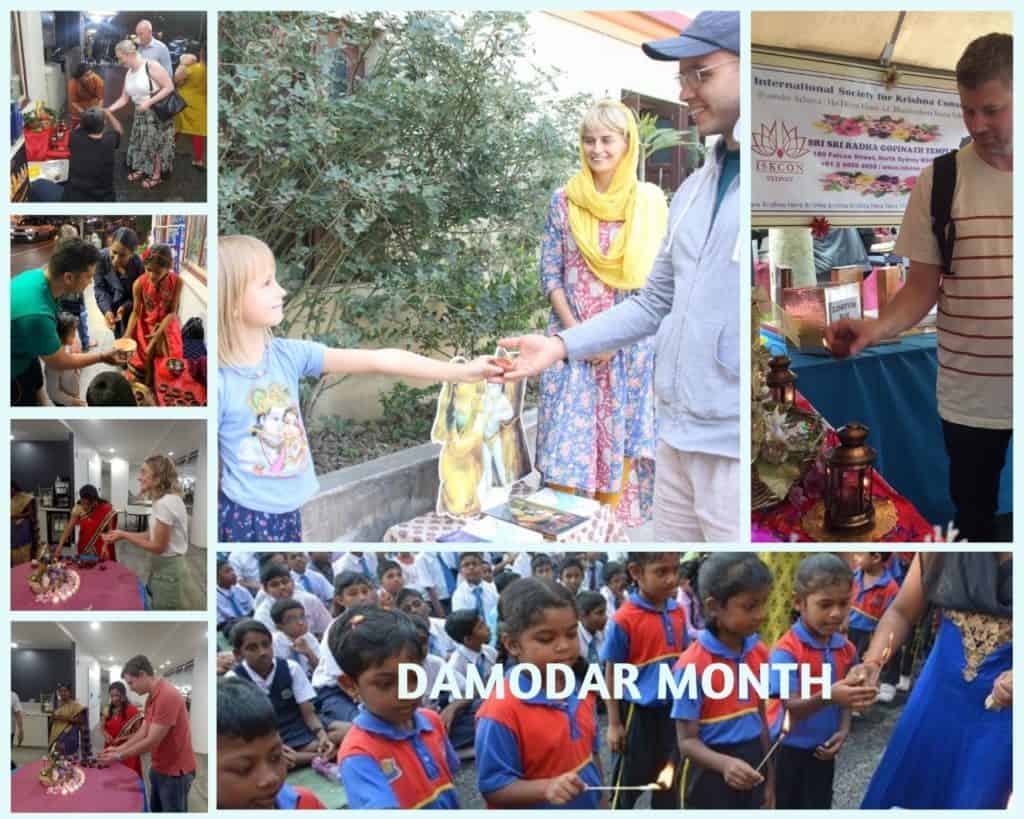
After a steady progress since the the launch of the Damodara Program,the momentum from the devotees took a dive when news about the health toll that had fallen on HH Jayapataka Swami swept across the world. Devotees were crying, feeling down and could hardly carry on with their regular chores. As days went by, they all realized the one thing they could do for HH Jayapataka that he would definitely be proud of was to carry on preaching and saving every soul on earth.
There has been a question regarding iPhone versions of Srila Prabhupada's books, in a comment to our article Cell Phones and Bhagavad-Gita. When the question was posted I was travelling without regular internet access and couldn't find the answer, which has been posted on the Google group World Sankirtan some time ago: KC books on iPhone 3G (version 2) by Candidasa Prabhu (personal blog). Here is the forum post with download links:
Srila Prabhupada is giving us the key to success for community development: it is this Vaikuntha atmosphere which we have to cultivate.
However, many times we only concentrate on the opulences of the spiritual world, thinking: if we make our temple very beautiful and attractive, then it will be just like Vaikuntha. We concentrate on the structure and form, and we forget the substance.
Of course, any project needs the development of both, substance as well as form and structure. Substance without form and structure becomes inefficient, and a structure without substance becomes like a hollow frame.
by Vasu Murti das
In your book "They Shall Not Hurt Or Destroy” you say a few years ago Norm Phelps came to the conclusion, such as I myself have, that the animal rights movement will never succeed until we 'convert' the churches, mosques and synagogues to our cause. Is this also your point of view?
Yes. I would like to see organized religion take up the struggle for animal rights. Religion has been wrong before. It has often been said that on issues such as women's rights and human slavery, religion has impeded social and moral progress. It was a Spanish Catholic priest, Bartolome de las Casas, who first proposed enslaving black Africans in place of the Native Americans who were dying off in great numbers.
The church of the past never considered human slavery to be a moral evil. The Protestant churches of Virginia, South Carolina, and other southern states here in the U.S. actually passed resolutions in favor of the human slave traffic.
by Deena Bandhu das,
sent to a PAMHO conference on 18 September 2008
An old classmate of mine sent me this:
Link: www.gethuman.com
When you're tired of wasting money, cell phone minutes, and, most importantly, your time due to phone systems that require you to press ten or more options in order to reach a real person and spending many minutes or even hours on hold, consult the GetHuman database of secret phone numbers and codes that immediately get an actual, live person on the line for customer service at nearly 1,000 major companies.
by Su-gita Vani dd
Please imagine a beautful photo of a book table here—I'm travelling and don't have access to photo editing software right now...
In the past our temple did book tables only in book fairs, local temple festivals and "Bhaagavath Saptaah(s)". But on Sunday, we did something different, we set up our table at a leading shopping complex here, in our area where we frequently shop. Because it is a commercial complex, they charged us a fee of Rs.500. The temple agreed to take this risk.
It was worth it because by the end of that day, our sales had crossed Rs. Six thousand. Two people even learned to chant.Seems people are looking for Krishna every where!
Within one hour I'm going to leave for South India, searching for an ayurvedic clinic or asram to take care of a variety of disorders that have developed in this body I've been carrying around for the last fifty-one years.
Generally South India has a better tech infrastructure than West Bengal, and I hope I will be able to continue looking after this website. Still, there may be some delay activating new user accounts and fixing imported articles that require manual attention (Google maps, embedded video or audio, or formatting irregularities).
by Ravindra Svarupa das
In the last two postings we have been considering a letter Srila Prabhupada wrote in 1972 concerning the nature of power. A devotee had written Prabhupada with misgivings about competition in activities of preaching. To this apparently simple and down-to-earth question, Prabhupada gave a reply that rose quickly to ultimate philosophical principles. Prabhupada's presentation is brilliantly compact; I have been unpacking it somewhat.
by Kripamoya das
When, for the first time, you've brought together your new people for a dinner party or small kirtan, discussion and prasadam, they'll probably want more. You can have a few regular meetings and give everyone time to settle down into being a member of something new. After some time there will be an important shift in the consciousness of the members. They will think more of themselves as a 'group of friends' and feel easy in each others company. The nervousness and over-politeness which governed proceedings earlier on will evaporate and the group will feel more comfortable in their new identity.
...This short film, made by a Christian group, illustrates some of the different unhelpful modes of behaviour that are prominent in small groups. Watch and try to translate it into small devotee group situations you may have been in yourself.—Watch Video
by Kripamoya das
Previously, I wrote about my experiences on the twelve week Alpha Course offered by the Christian Church. I explained what parts of my experience were helpful and which parts were disappointing. I wrote that as a short piece for some of my readers who are actively trying to bring spiritual seekers to Krishna, and who are therefore interested in hearing about any ideas that may make their task easier.
The Krishna consciousness movement is engaged in reaching out to others with its message. Part of the movement is engaged in "broadcasting," the wide dissemination of information; and part of the movement is engaged in "cultivation," when the seeds planted previously have sprouted and require further attention. The business of "preaching" must include both of these essential actions. Just as any intelligent farmer can"t reap a crop if he hasn"t both sown seed and cultivated, so there must be a series of stages in the matter of the cultivation of the soul.

Today I've noticed that many of our readers arrive at our site with browsers that have been infected with some nasty adware from FunWebProducts. This software offers smileys, cursors, and other fancy looking stuff for free—but you have to install their "search assistant" and browser toolbar in the process. This will change your homepage settings and generally take you to places you never intended to go.
Our E-bulletin Newsletter is sent out at irregular intervals to our subscribers and contains links to recently publishd articles, including teaser descriptions of the content.
You can download this newsletter's content (pdf) at this address (1.1 MB).
Recent comments
1 day 9 hours ago
1 day 9 hours ago
2 days 21 hours ago
4 days 12 hours ago
1 week 6 days ago
2 weeks 2 days ago
2 weeks 4 days ago
2 weeks 5 days ago
3 weeks 2 hours ago
3 weeks 1 day ago